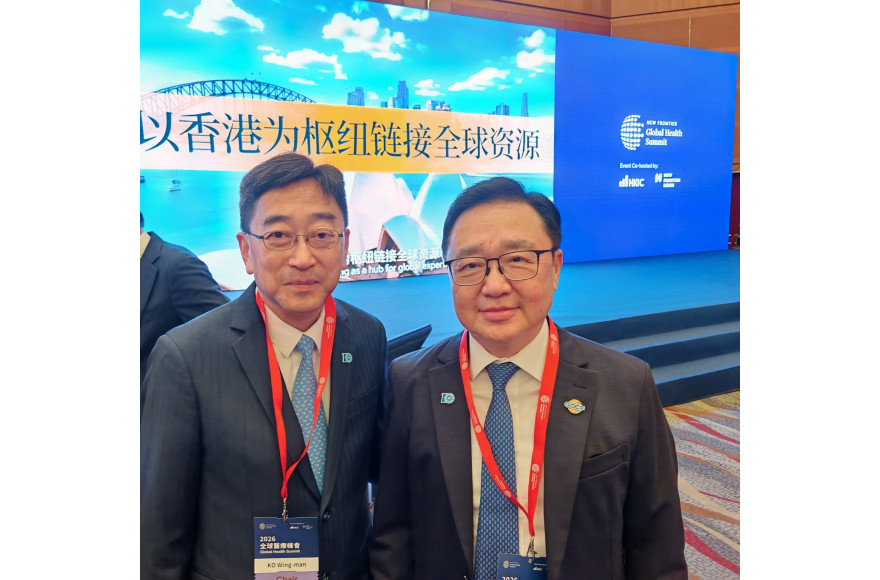
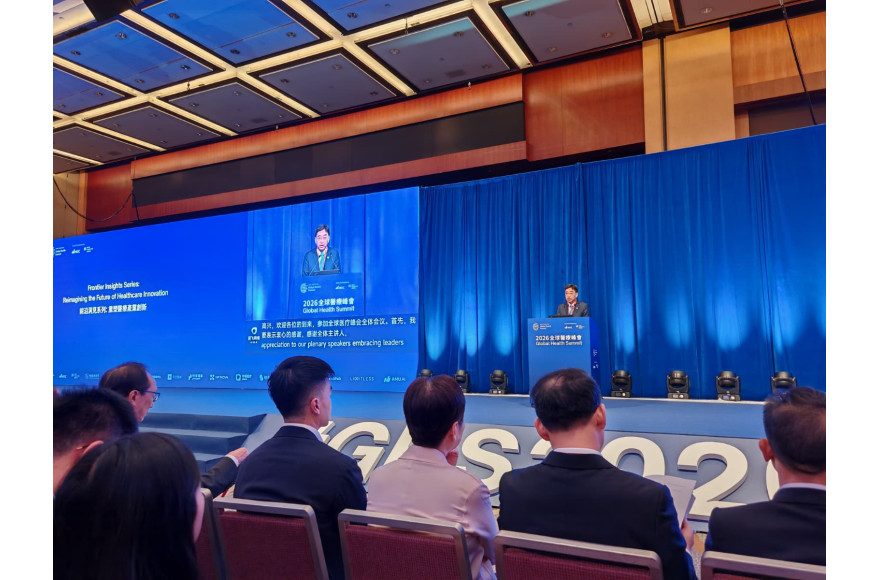
高永文醫生在 2026 全球醫療峰會主題「未來十年,如何引領亞洲醫療」發言全文
 2026年08月07日
以下是身兼大中華癌病基金會榮譽顧問的高永文醫生,以全國政協常務委員、香港特別行政區政府行政會議非官守議員、新風大灣區醫療集團董事、新風天域集團資深顧問身份,出席在2026年8月7日舉行的2026全球醫療峰會,題為「未來十年,如何引領亞洲醫療」主題演講全文:
Mr Antony LEUNG, Group Chairman of New Frontier Group,
Dr LEONG Che Hung, Prof Tony MOK, Conference Co-Chair
Distinguished guests, Professional Colleagues, ladies and gentlemen,
Good morning.
It gives me great pleasure to welcome you all to the Plenary Session of Global Health Summit 2026.
First of all, my utmost appreciation to our Plenary Speakers, embracing leaders and policy makers from the GBA and Asia, Leading academician and Leader of the 3rd ranking Global Financial Centre (GFCI).
This year marks the commencement of the National 15th 5-Year Plan. It is becoming clearer and clearer that the “Pursuit of High Quality Development” 高質量發展is not only about speed and scale. Whilst it necessarily embraces advancement in medical technologies and precision medicine, it also requires a system and policy perspective to re-invent an integrated and value-based healthcare system with focus on structure reform and macro-level financing incentives to deliver population health outcomes that commensurate with the overall national objectives for “Healthy China 2035”.
Hong Kong healthcare system has long been recognised internationally for achieving excellent health indices. Supported by a dual-track system of publicly funded and private healthcare, Hong Kong enjoys the world's highest life expectancies while maintaining modest healthcare expenditure as percentage of GDP.
However, like many developed economies, we face the common challenges of an ageing population, increasing chronic diseases and rising healthcare costs.
These challenges cannot be solved simply by building more hospitals nor just by improving hospital management as we had done via the Hospital Authority Reform.
Like Mainland China, Hong Kong has resolved to invoke a structural and paradigm transformation from medical perspective to health perspective, aiming at proactive community based wellness and prevention.
Primary healthcare is to be the cornerstone of this transformation.
The Government has been strengthening community-based care through District Health Centres, mandating the family doctor model, and established the Primary Healthcare Commission to better coordinate services across the public and private sectors. New initiatives such as the Primary Healthcare Co-governance Network further integrate disease prevention, health assessment, chronic disease management and multidisciplinary care into a seamless community-based system.
Healthcare should not begin when people become patients. It should begin long before illness develops.
This life-course approach recognises that health promotion starts from before birth and continues throughout childhood, adulthood and healthy ageing. Prevention, early intervention and health literacy are becoming central pillars of healthcare policy rather than supplementary programmes.
In the past 2 decades, new and innovative technologies have greatly improved disease prevention and efficacy of medical treatment, making health care more effective and accessible. At the clinical frontline, clinicians and patients alike have been beneficiary of emerging novo treatment for cancers such as target therapy, immune therapy and cell therapy. During COVID pandemic, we also witnessed the mRNA platform enabling ultra-fast design and production of vaccine, matching the rapid appearance of new viral strains. A.I. supported diagnostics improved the speed and accuracy of medical imaging, pathology and risk scoring. Telemedicine enabled the remote provision of medical support both at primary care level and specialized clinical consultation as well as surgical oversight. AI empowered robotics have also assisted surgeons in further development of minimal invasive surgery and enhanced surgical precision.
However, the exponential scene is widely believed to be at the door step. AI driven predictive diagnosis and drug discovery, next generation genomics ad gene editing, tissue and bioprinting , neurotechnology and brain computer interfaces, nanomedicine, autonomous robotics …… It is up to the healthcare system to harness these technologies in the process of re-imaging health care delivery and re-designing the healthcare system. It would be more important for the health care workers to engage with the science sector in development process to ensure the utility and value-base of frontier science and medicine.
Quite apart from the user’s angle, Hong Kong sees the clear role in being an important driver in the national and international perspective for biomedical innovation. In this regards, Hong Kong align its vision to become an international health and medical innovation hub with the National 15th Five Year Plan and our own inaugural Five-Year Plan, and Biomedicine is designated as a strategic emerging pillar industry. With internationally ranked Universities, Outstanding Medical Schools, world-class clinical experts, internationally recognised regulatory and research standard, a well respected common law system, strong intellectual property protection, global connectivity and not least a vibrant capital market, Hong Kong is well placed as a ecosystem to integrate scientific research, clinical medicine, advanced manufacturing, and real world application and international propagation. More importantly, under the “One Country, Two System” arrangement, Hong Kong enjoys unparalleled access to the Mainland Market whilst maintaining a high degree of international connectivity. This unique position becomes even more significant with the development of the Northen Metropolis and the Hong Kong – Shenzhen Innovation and Technology Park. Through close collaboration with Shenzhen and GBA Hong Kong can combine world leading basic research and clinical investigation with Mainland’s enormous manufacturing capability, engineering excellence and rapidly expanding innovation capacity. In this regards, the establishment of the Hong Kong Centre for Medical Products Regulation (CMPR) will further enhance the globalization of products of biomedical innovation both from locally and from the Mainland through close collaboration in clinical trial at the HK-SZ Innovation and Technology Park.
Ladies and gentlemen,
The future of health innovation is not defined solely by better hospitals or more advanced technology.
It will be defined by how effectively we integrate healthcare reform with scientific innovation, industrial development and international collaboration. Hong Kong is uniquely positioned to contribute to this.
By strengthening primary healthcare, embracing prevention, accelerating biomedical innovation, fully developing the Northern Metropolis and HK-SZ Collabration platform, and serving as the international gateway for China's life sciences industry, Hong Kong can make an important contribution not only to better health, but also to sustainable economic development and global medical progress.
Thank you very much.